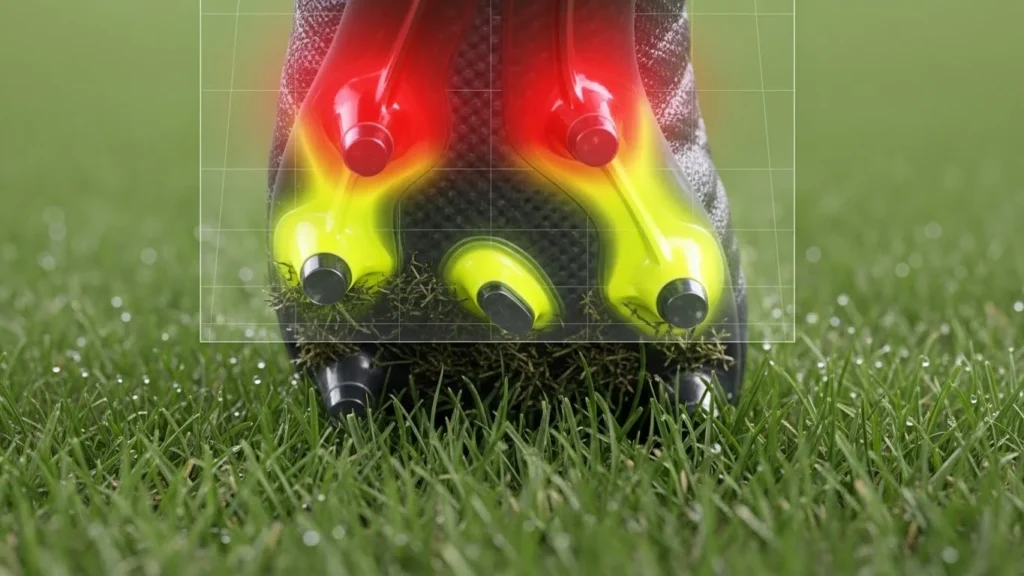
You buy new cleats and the first 20 minutes feel perfect. Then your forefoot starts to burn. By minute 75, every hard cut feels sharp under the ball of your foot. Most players assume it is just a lack of fitness, but the science tells a different story. It is a result of complex biomechanical shifts happening between your skin and the pitch.
Foot Anatomy and Pressure Mapping reveal that cleats concentrate force into small studs, creating hot spots. As muscles fatigue, this force shifts dangerously toward the heel and metatarsals. The right stud pattern manages this stress, keeping you stable until the final whistle.
The Biomechanical Marvel of the Human Foot
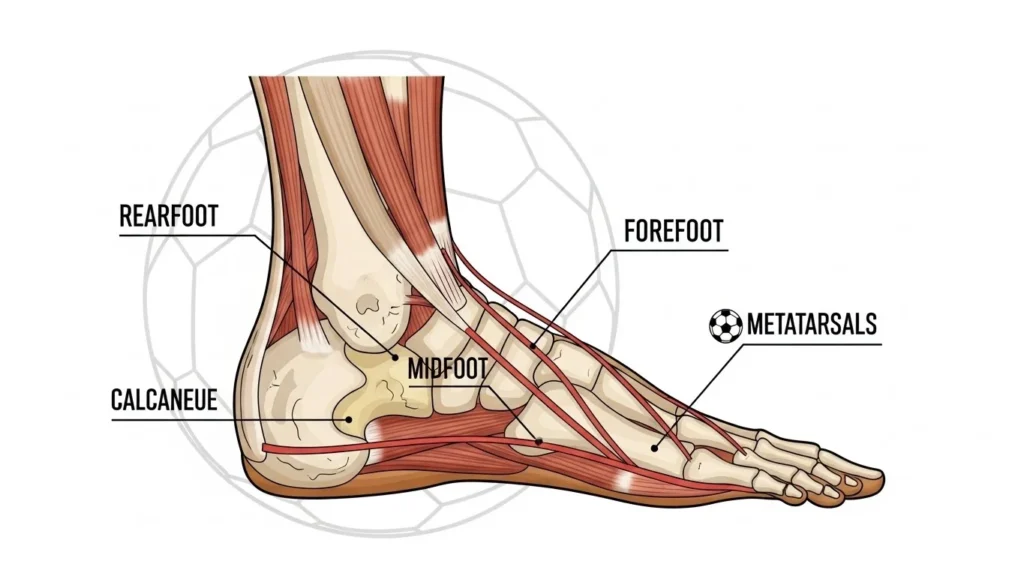
Your foot contains 26 bones and 33 joints, designed to act as both a soft shock absorber and a rigid lever. A key component of this system is the plantar fascia, a thick band of tissue that acts like a bowstring to keep your arch strong. When you lift your toes to push off, this band tightens in a process called the windlass mechanism, creating the power you need for a sprint or a shot.
This system is efficient when your muscles are fresh. However, your foot also relies on small intrinsic muscles for stability. By the 70th minute, these muscles often run out of energy, causing the windlass mechanism to become less effective. As a result, the foot becomes mechanically softer and less stable under heavy loads.
What Pressure Mapping Actually Measures
Scientists use high-tech sensors to measure the load between your foot and your boot, turning your movement into a data-driven heat map. There are three metrics that matter most to players:
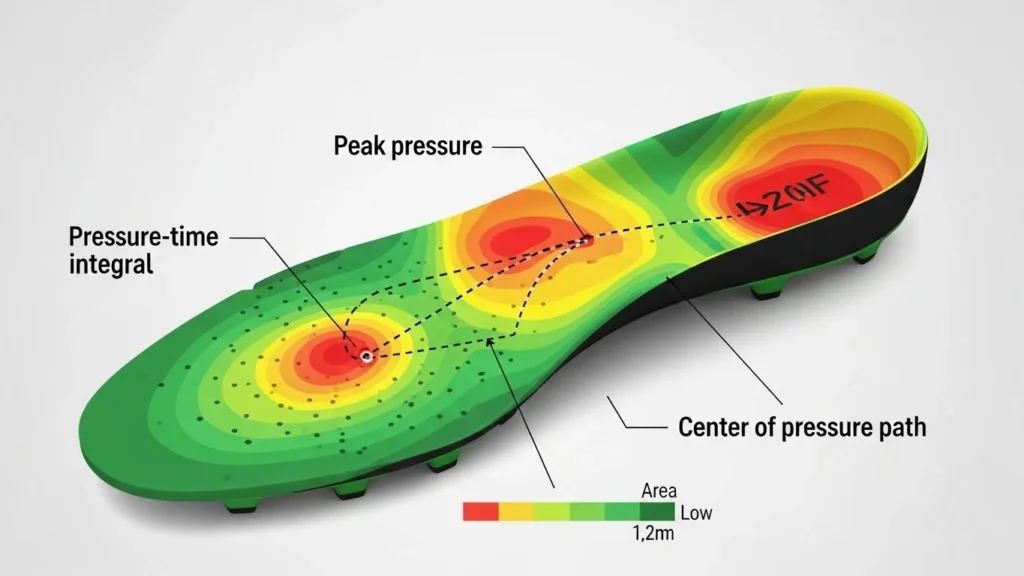
- Peak Pressure: The highest spike of force in a specific zone at one moment.
- Pressure-Time Integral (PTI): The total accumulated load over 8,000 to 10,000 steps.
- Center of Pressure (COP): The path your weight takes during a stride.
While Peak Pressure explains a sharp pain, the PTI explains deep fatigue. Research shows that during a 45-degree cut, the pressure on your inner foot can jump by 50%. This is why players feel hot spots on the medial side after heavy training sessions.
The 90-Minute Fatigue Cascade
As the match progresses, your body uses up glycogen fuel. Your calf and foot muscles can no longer support the arch effectively, leading to a dangerous shift in movement mechanics. Early in the game, your load path is smooth. Late in the game, pressure mapping shows a backward migration where forefoot peaks drop and heel loading rises.
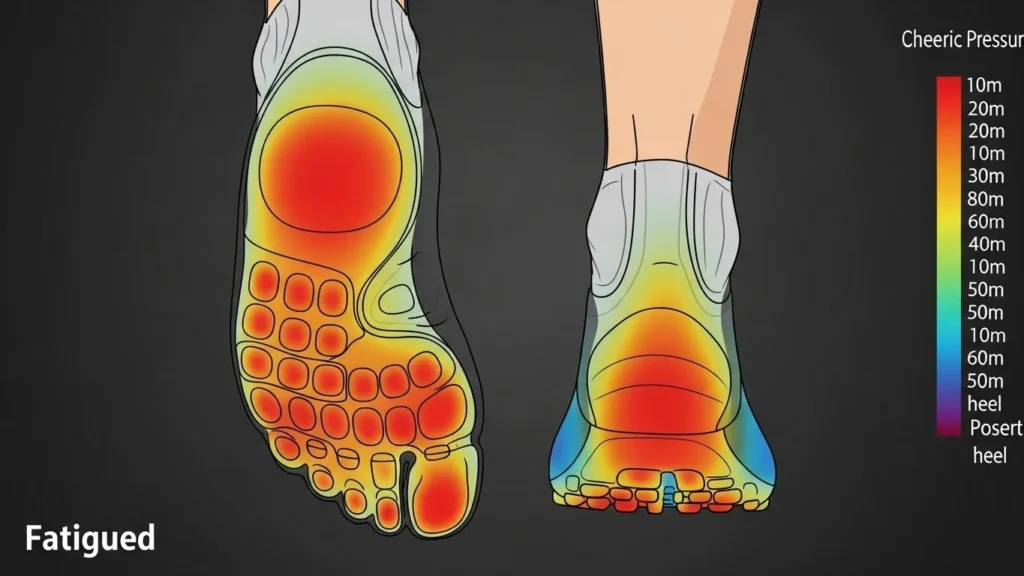
This redistribution puts extra stress on the second and third metatarsal bones. These thin bones are not designed to carry the primary load of a sprinting athlete. This steady accumulation of pressure is a common cause of ball-of-the-foot discomfort. Furthermore, your side-to-side stability decreases, making planted cuts feel jolting rather than clean.
How Stud Patterns Influence Loading
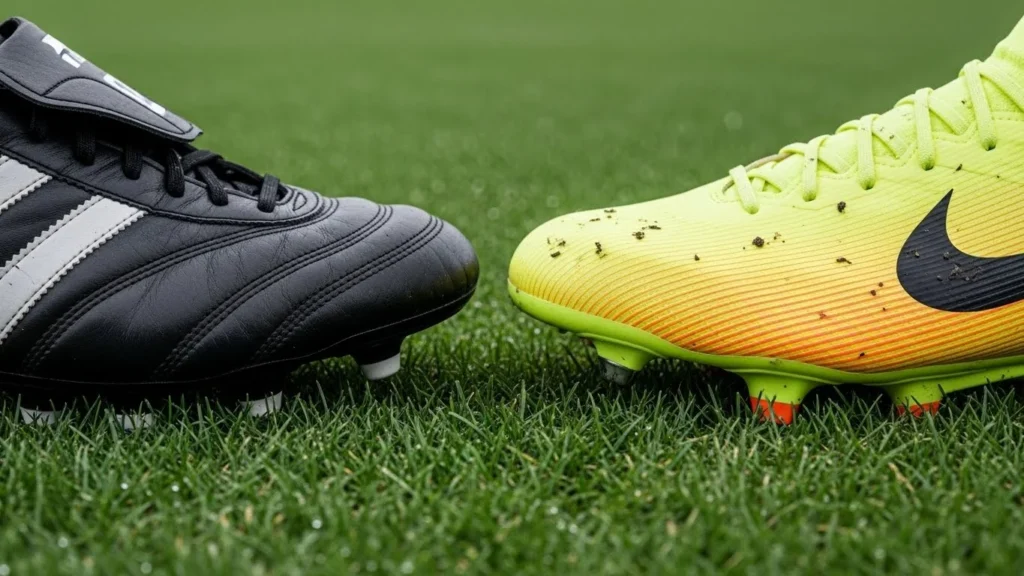
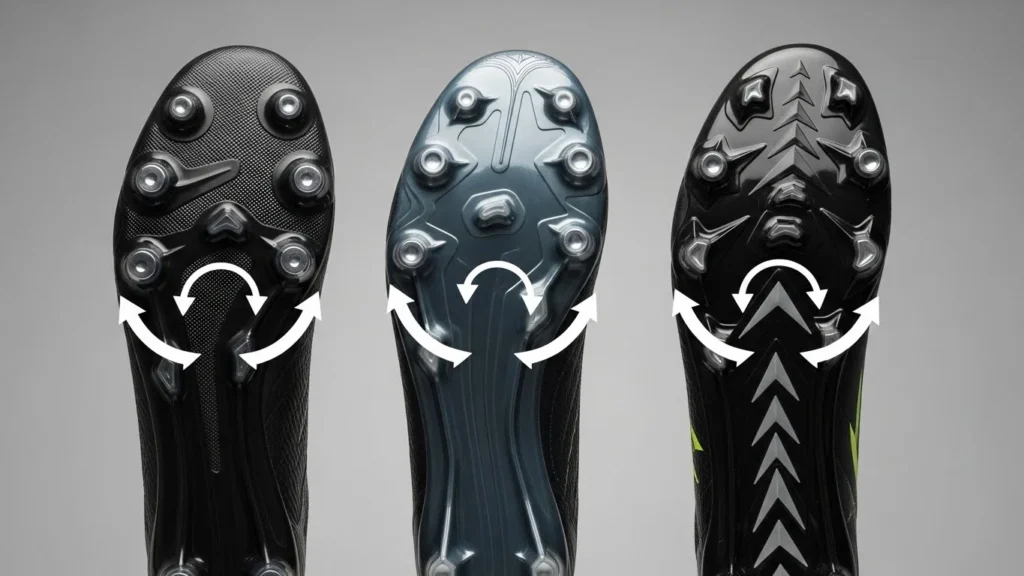
The layout and shape of your studs dictate how your foot absorbs force. Bladed studs offer incredible traction but increase rotational resistance. This can cause the foot to stick to the ground while the body keeps moving, raising the torque placed on the foot and ankle.
Round or conical studs allow for more natural rotation and often feel less harsh late in the match. Research suggests that very aggressive stud patterns on sticky surfaces increase the odds of lower-body stress. For players on hard ground, using Multi-Ground (MG) or Artificial Grass (AG) plates is a smart strategy to spread contact points and lower the Peak Pressure on any single zone.
Gear Selection Checklist: Reducing Late-Match Fatigue
If you hate late-match foot fatigue, focus on these four gear priorities:
- Match traction to the surface: Use MG or AG plates on hard surfaces to spread the load.
- Stable medial platform: Ensure the boot chassis supports the inside edge of your forefoot.
- Consistent cushioning: Look for insoles that reduce sharp spikes without feeling mushy.
- Prioritize fit: A narrow toe box amplifies pressure on the metatarsals. Ensure room for natural toe splay.
Female Player Notes: Unique Fatigue Responses
Research suggests that fatigue responses are not uniform across sexes. Female players often exhibit longer ground contact times as fatigue sets in, which can lead to greater side-to-side instability in the center of pressure. If you are a female player, testing traction and stability late in a session is critical. A boot that feels stable while fresh may feel too aggressive or “catchy” once muscle fatigue alters your movement strategy.
Simple Self-Checks for Players
You can perform these checks without lab gear to find the pattern behind your discomfort:
The Hot Spot Check: Notice where soreness appears first. Medial forefoot pain suggests heavy cutting load. Heel soreness that increases late suggests a backward shift in loading.
The Stud Imprint Check: Remove the insole after training and look for repeated dark circles or compressed zones. A persistent cluster of marks usually matches a pressure hot spot. If the marks are very narrow, your setup is transmitting too much force into too few areas.
Conclusion
Stud pressure is a matter of real physics. Your foot is an active system early in a match, but as fatigue builds, that control becomes less precise. Understanding Foot Anatomy and Pressure Mapping allows you to choose gear that works with your body, not against it. By matching your stud pattern to your surface and movement style, you can protect your foundation and stay at your peak until the final whistle.
Sources and References:
- Wong, P., et al. (2006). “Higher plantar pressure on the medial side in four soccer-related movements.” British Journal of Sports Medicine.
- Karolidis, E., et al. (2025). “Effect of football cleat stud shape, sex and fatigue state on plantar pressure distribution.” BMJ Open Sport & Exercise Medicine.
- The Lab Rehab (2025). “Cleat stud patterns & injury risk.”
- Physiopedia (2024). “Foot and ankle structure and function.”